California Weekly Roundup: Families Search for Hospitalized ICE Detainees
Get link
Facebook
X
Pinterest
Email
Other Apps
Plus: California's budget hole; the latest on ACA subsidies; mental health hospitals warn of cuts; Planned Parenthood funding; gender care in California; measles at Disney California Adventure Park; and more
Lydia Romero strained to hear her husband's feeble voice through the phone.
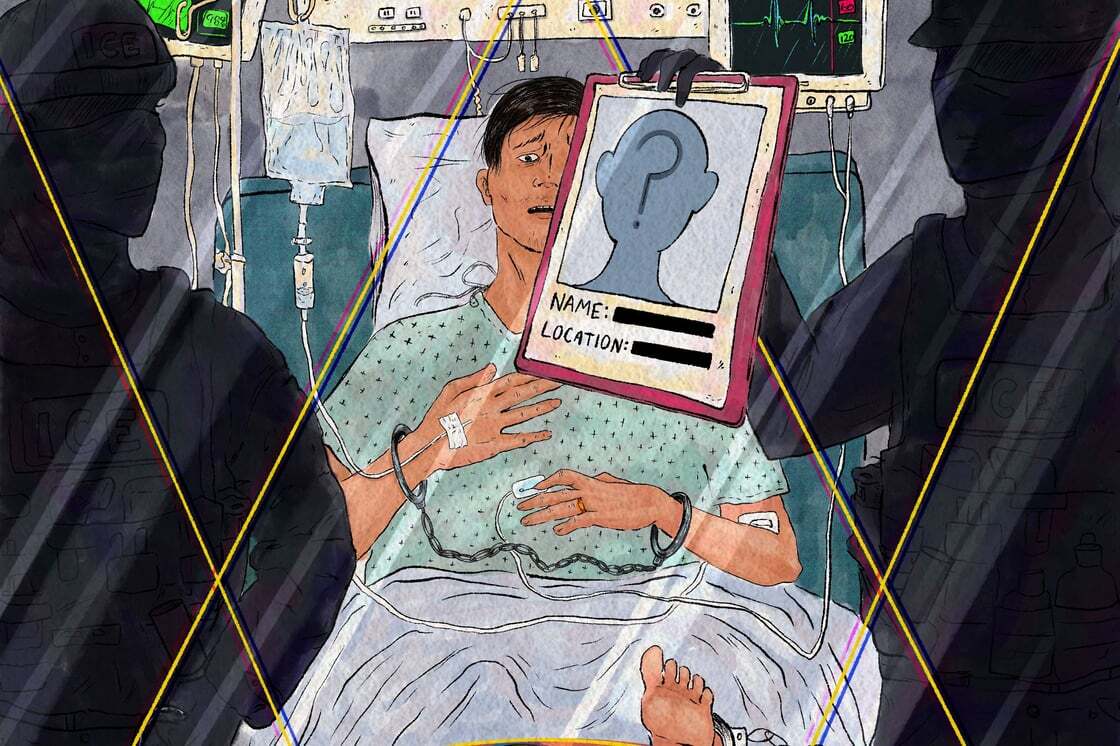
A week earlier, immigration agents had grabbed Julio César Peña from his front yard in Glendale, California. Now, he was in a hospital after suffering a ministroke. He was shackled to the bed by his hand and foot, he told Romero, and agents were in the room, listening to the call. He was scared he would die and wanted his wife there.
"What hospital are you at?" Romero asked.
"I can't tell you," he replied.
Viridiana Chabolla, Peña's attorney, couldn't get an answer to that question, either. Peña's deportation officer and the medical contractor at the Adelanto ICE Processing Center refused to tell her. Exasperated, she tried calling a nearby hospital, Providence St. Mary Medical Center.
"They said even if they had a person in ICE custody under their care, they wouldn't be able to confirm whether he's there or not, that only ICE can give me the information," Chabolla said. The hospital confirmed this policy to KFF Health News.
Family members and attorneys for patients hospitalized after being detained by federal immigration officials said they are facing extreme difficulty trying to locate patients, get information about their well-being, and provide them emotional and legal support. They say many hospitals refuse to provide information or allow contact with these patients. Instead, hospitals allow immigration officers to call the shots on how much — if any — contact is allowed, which can deprive patients of their constitutional right to seek legal advice and leave them vulnerable to abuse, attorneys said.
Hospitals say they are trying to protect the safety and privacy of patients, staff, and law enforcement officials, even while hospital employees in Los Angeles, Minneapolis, and Portland, Ore., cities where Immigration and Customs Enforcement has conducted immigration raids, say it's made their jobs difficult. Hospitals have used what are sometimes called blackout procedures, which can include registering a patient under a pseudonym, removing their name from the hospital directory, or prohibiting staff from even confirming that a patient is in the hospital.
"We've heard incidences of this blackout process being used at multiple hospitals across the state, and it's very concerning," said Shiu-Ming Cheer, the deputy director of immigrant and racial justice at the California Immigrant Policy Center, an advocacy group.Read the full story.
Follow us online for more KFF Health News coverage:
Gavin Newsom is making a billion-dollar gamble in his latest budget plan, banking on money from a tax on health insurance carriers to help close a projected deficit. (Bluth, 1/28)
All nine California Republicans voted for the bill. Forty-two of the 43 California Democrats voted no. The only Democratic yes vote was Rep. Scott Peters, D-San Diego. (Lightman, 2/3)
The spending package approved this week keeps the federal government funded, but it does not address the expiration of key Affordable Care Act health care subsidies—an issue that lawmakers say was the primary driver of last year's record 43-day government shutdown. (Ming, 3/3)
As massive federal cuts are upending the health care system in California, analysts and health care professionals are urging the state to soften the blow by creating new revenue streams and helping residents navigate through the red tape. (King, 2/1)
New enrollment in California's Affordable Care Act health-insurance marketplace fell by nearly one-third from the previous year, according to state officials, with federal insurance-premium subsidies no longer in place. (Gurevich, 2/2)
Rep. David Valadao cast the deciding vote to slash Medicaid despite representing a California district where 64% of constituents rely on it. (Miller, 2/2)
New federal restrictions and requirements to the federal Supplemental Nutrition Assistance Program (SNAP)started Feb. 1. Here's what to know. (Bridges, Walrath-Holdridge, and Segura, 2/3)
Over 30,000 health care workers at Kaiser Permanente hospitals in California and Hawaii continue their strike for better pay and staffing. (Hicks, 2/2)
Operators expect to close the emergency room and stop offering acute care services on site as they consider the future of Providence Mission Hospital Laguna Beach. (Ritchie, 2/2)
The Trump administration on Wednesday sought to join a federal lawsuit alleging that UCLA's David Geffen School of Medicine illegally considers race in admissions. (Kaleem, 1/28)
California will bolster funding for Planned Parenthood and other providers of reproductive health with a one-time infusion of $90 million. (King, 1/30)
A California doctor this week became the first physician to be sued under a new Texas law that allows private citizens to pursue civil legal action against anyone who provides abortion medication in Texas. (Fry, 2/3)
Orange County confirmed a measles case from an international traveler who visited Disney California Adventure Park. L.A. County confirmed its third case in a resident who went to a Sherman Oaks restaurant. (Lin and Harter, 2/2)
They also extended an air purifier distribution program, which doctors and scientists have said is a critical short-term strategy to improve health conditions for residents. (Salata, 1/29)
L.A. County Board of Supervisors' move Tuesday to cut nearly $200 million in programs to help the homeless will hit outreach and navigation services hard. (Khouri, 2/3)
Neighborhood leaders allege new homeless services are still concentrated in SoMa even after the passage of a new law that calls for the even distribution of shelters across San Francisco. (Gurevich, 2/2)
The Point-in-Time count is widely considered an undercount, but it is the closest thing to an accurate count of the unhoused population. (Futterman, 1/29)
When police in California stop a driver or pedestrian whom they believe to be homeless, they're far more likely to search, handcuff, deploy force against and arrest that person than others they pull over, a new state report says. (Egelko, 2/3)
The high court ruled that police must find marijuana in a condition that's ready to be smoked if they are going to charge a driver with an open container violation. (Duara, 1/29)
Since 2021, Gov. Newsom said, National Guard troops have seized 34,357 pounds of fentanyl worth an estimated $506 million at California ports of entry. (Brennan, 2/3)
Gov. Gavin Newsom's account of his mother's death at 55 by assisted suicide is one of the most revealing passages in the California governor's book, "Young Man in a Hurry: A Memoir of Discovery," which will be published Feb. 24. (Reston, 2/4)
An expensive new gene therapy that can potentially cure people with sickle cell disease will be covered by Medicaid, but only when it works for patients. Plus, community health centers are preparing to help care for millions more uninsured people.
KFF Health Newsis a national newsroom that produces in-depth journalism about health issues and is one of the core operating programs at KFF — the independent source for health policy research, polling, and journalism.
(c) 2026 KFF. All rights reserved.
KFF
185 Berry St., Suite 2000, San Francisco, CA, 94107, United States
Get your first pass at the day's top health care policy news. View on our site , with interactive table of contents. Not a subscriber? Sign Up Thursday, May 09, 2024 Visit KFF Health News for the latest headlines First Edition Today's early morning highlights from the major news organizations. KFF HEALTH NEWS ORIGINAL STORIES KFF Health News: Paid Sick Leave Sticks After Many Pandemic Protections Vanish Bill Thompson's wife had never seen him smile with confidence. For the first 20 years of their relationship, an infection in his mouth robbed him of teeth, one by one. "I didn't have any teeth to smile with," the 53-year-old of Independence, Missouri, s...










.png?width=300&upscale=true&name=CA%20general%20150px%20(1).png)

Comments
Post a Comment